
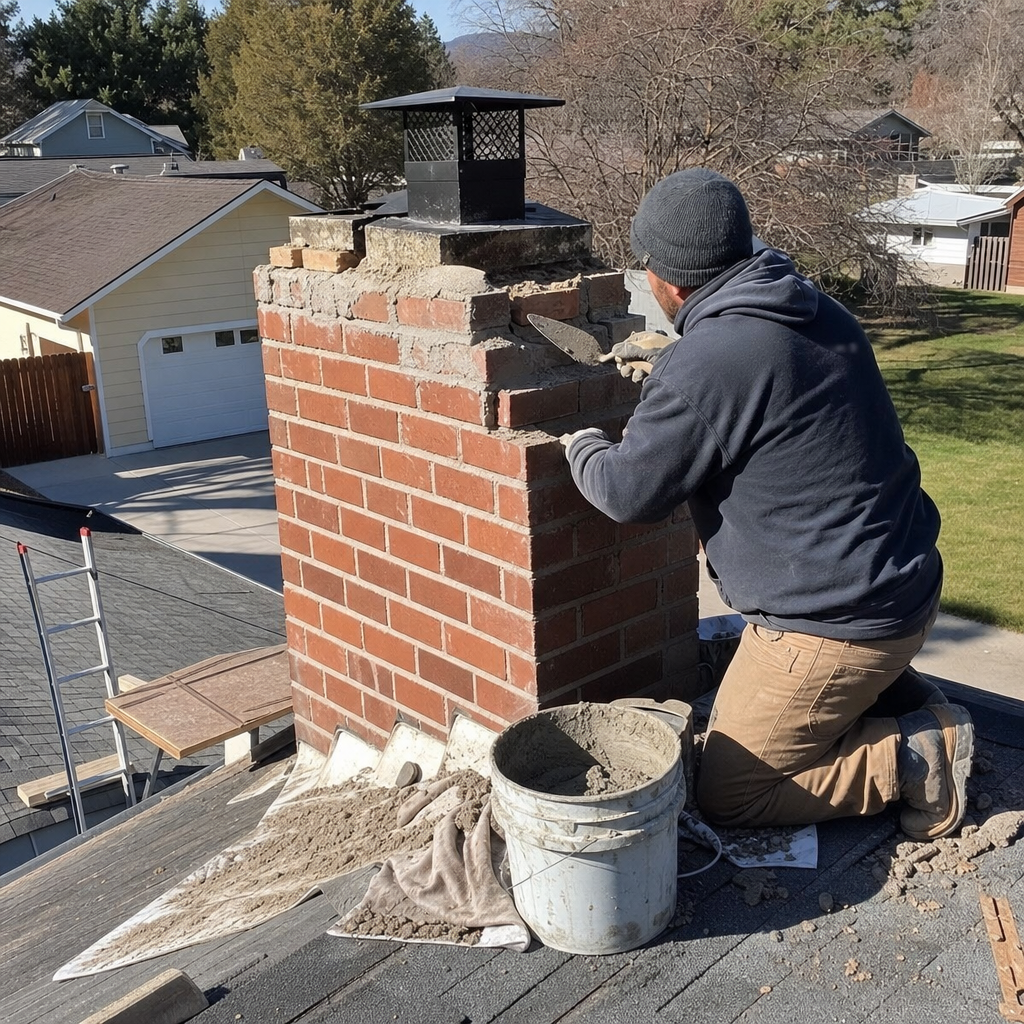
Chimney Flashing Repair in Spokane: What It Actually Costs and When You Need It
Chimney flashing repair in Spokane typically runs $100–$250 for a sealant patch on recent flashing with minor separation, or $400–$900+ for a full reflash when step flashing is corroded, improperly lapped, or original to an 80–120-year-old home. Most jobs we diagnose are the full reflash — Spokane’s freeze-thaw cycles separate even well-installed flashing from mortar joints within 5–10 years. Call (833) 749-2788 for a free inspection and exact quote; Anthony Perez, our owner and lead technician, handles every assessment personally.
When a Spokane homeowner tells us they have a chimney leak, the first thing we check is the flashing. Not because it’s always the culprit, but because in a climate with this many freeze-thaw cycles, it usually is — and it looks fine from the attic until it suddenly isn’t. Last October, we were on a South Hill craftsman where the homeowner had patched the same corner with roofing cement three times. The counter flashing hadn’t moved; the mortar joint behind it had crumbled from thermal cycling. Caulk over crumbling brick is like painting over rot.
Why Spokane’s Climate Destroys Flashing Faster Than Almost Anywhere
Here’s the mechanism most roofers don’t explain: your chimney is masonry, and your roof deck is wood. They expand and contract at different rates. Every degree change creates micro-movement at that junction. Spokane sees roughly 49 inches of snow annually with prolonged hard freezes from October through March — that’s hundreds of freeze-thaw cycles per winter, year after year.
In milder climates, that junction might move meaningfully fifty times a year. In Spokane, it’s moving three or four hundred times. The cumulative effect separates counter flashing from mortar joints even when the original installation was correct. We’ve pulled apart flashing on Browne’s Addition homes that was installed in the 1990s with proper lead sealant — the sealant hadn’t failed; the brick face had spalled behind it.
This matters because it changes what “repair” means. If your flashing is recent and the separation is minor, a proper sealant job with backer rod and masonry-compatible sealant can last. If your home is one of Spokane’s 80–120-year-old brick structures — common in the Perry District, South Hill, and Browne’s Addition — the original flashing is likely lead or galvanized steel that’s now corroded, and the mortar joints behind it have been cycling for decades. A caulk job on that assembly is temporary at best and sometimes traps moisture against deteriorating brick.
How Chimney Flashing Actually Works (and Why Most Quotes Are Guesses)
Chimney flashing is two separate systems working together. Most homeowners don’t know this, which is why phone quotes for “flashing repair” are often meaningless.
- Step flashing: L-shaped metal pieces woven into each course of shingles and bent up against the chimney. This is the water barrier that carries roof runoff past the chimney-wall junction. When step flashing corrodes, is improperly lapped, or was installed with exposed nails, water runs behind it directly into your attic.
- Counter flashing: The metal cap embedded into mortar joints or cut into brick courses, folded down over the step flashing. This protects the top edge of the step flashing and directs water outward. When counter flashing separates from mortar — the classic Spokane failure — water runs down the chimney face and behind the step flashing system.
We can’t tell you which has failed without getting on the roof. Last Tuesday, we diagnosed a leak in a North Side home where the homeowner was certain it was counter flashing separation. The step flashing was actually missing entirely on the downslope side — a roofer had tucked shingles tight to the brick without any metal. The water was entering six feet from where the ceiling stain appeared. That’s why we don’t quote over the phone for flashing work.
Anthony Perez, our owner and lead technician, runs every job himself — you won’t get a subcontractor with a clipboard. He’ll trace the leak path, identify which component has failed, and show you before recommending anything. Chimney repair is what we do; we’re not generalists who happen to have a ladder tall enough.
Sealant Patch vs. Full Reflash: A Decision Tree
This is where we part ways with competitors who sell every job the same way. The right fix depends on four factors we assess on-site:
| Scenario | Appropriate Fix | Typical Range |
|---|---|---|
| Flashing installed within last 10 years, minor counter flashing separation, sound mortar joints | Sealant patch with backer rod and masonry-compatible sealant | $100–$250 |
| Original flashing 20+ years old, galvanized steel or lead showing corrosion, minor mortar deterioration | Partial reflash: new counter flashing, assess step flashing | $300–$600 |
| Pre-1950s home with original flashing, significant mortar spalling, or step flashing improperly lapped/missing | Full reflash: new step flashing, new counter flashing, mortar repair | $400–$900+ |
| Chimney rebuild required due to extensive brick deterioration; flashing secondary to structural issue | Rebuild with integrated flashing system | Quoted after structural assessment |
The age of your Spokane home is a strong signal. Those 1900s–1940s craftsman bungalows and late-Victorian homes in the older neighborhoods? Their original flashing was often lead or galvanized steel that is now corroded beyond patching. We’ve never successfully patched original flashing on a 1920s South Hill brick chimney and had it last more than two winters. The thermal cycling is too aggressive, and the metal is too far gone.
Conversely, we did a sealant patch last November on a 2005 home in the Five Mile area where the counter flashing had simply pulled from a single mortar joint. The step flashing was stainless, properly lapped, and in perfect condition. That repair took 45 minutes and the homeowner’s been dry through two freeze-thaw seasons. The difference is knowing which situation you’re in — and that requires someone who understands chimneys specifically, not just roofs generally.
Why a Chimney Specialist Sees What Roofers Miss
Here’s a pattern we’ve seen dozens of times: homeowner calls a roofer for a chimney leak. Roofer inspects, says flashing looks fine, suggests re-shingling the chimney apron or points to the cap. Homeowner pays for roof work, leak continues. Eventually they call us.
Anthony runs every job himself, and our chimney-only scope means flashing assessment happens alongside crown and cap inspection on the same visit. We identify whether the source is flashing separation, crown cracking, or a deteriorated cap — three distinct failure modes that can produce similar interior stains. A roofer inspecting chimney flashing often lacks the chimney-specific context to distinguish them, and may refer the job out to a chimney contractor after you’ve already paid for their diagnosis.
We use materials from brands we trust — HeatShield for crown repair when that’s the actual source, Gelco and Famco for cap replacements, Olympia Chimney components when liner condition is part of the assessment. The point isn’t brand-dropping; it’s that we specify the right material for your chimney’s condition rather than applying a universal fix.
Our home page outlines our full service range, but on flashing jobs specifically, the integrated assessment matters. Last season, we arrived at a Perry District home for what the homeowner described as “flashing repair.” The counter flashing had minor separation, yes — but the crown was cracked through to the flue tile, and the cap was rusted open. Fixing only the flashing would have left two active leak paths. We handle it start to finish, so the homeowner got one visit, one quote, and one accountability point.
Spokane’s Wood-Burning Season Adds Urgency Most Cities Don’t Face
Spokane’s continental cold winters drive heavy fireplace and wood stove use, but the Spokane Regional Clean Air Agency enforces seasonal burn bans when winter temperature inversions trap smoke in the river basin. On Stage 1 or Stage 2 curtailment days, you can only legally burn if your appliance is certified and your chimney is clean — and even then, only on “green” air quality days.
A flashing leak that damages your firebox or liner doesn’t just risk water damage; it can take your heating source offline during the narrow windows when burning is permitted. We’ve had homeowners call in January after a leak saturated their firebox brick, watching a clear cold week pass while they waited for repairs. If your chimney is leaking, addressing it before the deep freeze isn’t preventive maintenance — it’s protecting your usable heat source for the season.
What Happens During Our Flashing Inspection
Anthony arrives, ladders the roof, and works through a specific sequence:
- Visual assessment of counter flashing embedment in mortar joints — looking for separation, spalling, or sealant failure
- Lift shingles at chimney corners to inspect step flashing condition, lap direction, and fastener placement
- Water test or moisture meter reading of attic sheathing at chimney penetration to confirm active leak path
- Crown and cap inspection to rule out alternative leak sources
- Interior firebox and hearth inspection for water staining that indicates leak duration
We photograph everything and review it with you before quoting. If it’s not safe to light, we’ll tell you before we pack up — not after. That’s eleven years of chimney-only work and nearly 900 homeowner reviews informing how we operate. No subcontractor will arrive in our place; Anthony leads every job.
FAQs
Chimney flashing repair in Spokane costs $100–$250 for a sealant patch on recent flashing with minor separation, or $400–$900+ for a full reflash when step flashing is corroded, improperly lapped, or original to an older home. The exact price depends on which flashing component has failed, the age and condition of your chimney’s mortar joints, and whether the leak source is confirmed as flashing or something else. Call (833) 749-2788 for a free inspection and exact quote — estimates are free.
A sealant patch is cheaper upfront but wastes money if your flashing is original to a pre-1950s home or shows corrosion. On Spokane’s 80–120-year-old brick homes, original lead or galvanized steel flashing is typically corroded beyond patching, and mortar joints behind it have deteriorated from decades of freeze-thaw cycling — a full reflash is the only lasting fix. We assess this on-site and won’t sell a patch where a reflash is needed. Call (833) 749-2788 for an honest evaluation.
We can diagnose and often repair flashing through most of the winter, but sealant applications need dry surfaces and temperatures above manufacturer specifications for proper curing. Spokane’s prolonged hard freezes from October through March mean we sometimes need a clear, dry day for the most reliable sealant work. Emergency temporary measures are possible to stop active leaks, with permanent repair scheduled during a weather window. If you’re seeing active water intrusion, call (833) 749-2788 — we’ll stop the damage first and finish properly when conditions allow.
Flashing leaks typically show as stains on ceiling drywall adjacent to the chimney or damp attic sheathing at the chimney penetration; crown leaks often produce water running down the interior flue; cap leaks may show as water in the firebox during rain without corresponding ceiling stains. Only a rooftop inspection can confirm the source — we’ve traced “flashing” leaks to cracked crowns and vice versa. Our integrated chimney assessment identifies the true source on one visit rather than paying for multiple trades to guess. Call (833) 749-2788 to schedule with Anthony directly.
Ready to Stop the Leak? Call for a Free Inspection
Chimney flashing failure in Spokane is a freeze-thaw problem, not a mystery — and the fix depends on which component has failed, not on a one-size-fits-all approach. Anthony Perez, owner and lead technician at Premier Chimney Cleaning Greater Spokane, handles every flashing assessment personally, with 11 years of chimney-only specialization and nearly 900 verified reviews behind the work. We’ll tell you honestly whether you need a patch or a reflash, and we’ll identify any crown or cap issues while we’re on your roof. Call (833) 749-2788 today for a free estimate — no subcontractor, no upsell, just a straight answer about what’s actually leaking.
Written by Anthony Perez, Owner & Lead Technician at Premier Chimney Cleaning Greater Spokane, serving Spokane, WA.